If you’ve ever searched for something on Google and clicked one of the first few results, you’ve already experienced the power of Search Engine Optimization (SEO).
SEO is one of the most effective digital marketing strategies for attracting organic traffic, generating qualified leads, and growing your business without paying for every click.
Whether you’re a business owner, blogger, freelancer, or complete beginner, this guide will explain everything you need to know about SEO in 2026—including how search engines work, the different types of SEO, ranking factors, common mistakes, and practical tips to help your website rank higher.
What is SEO?
Search Engine Optimization (SEO) is the process of improving your website so it appears higher in search engine results when people search for relevant keywords.
The goal of SEO is simple:
- Increase organic (free) traffic
- Improve website visibility
- Build trust and authority
- Generate more leads and sales
- Provide a better user experience
Unlike paid advertising, SEO helps you earn traffic naturally by creating valuable content and optimizing your website according to search engine best practices.
Why is SEO Important in 2026?
Search behavior continues to evolve with AI-powered search experiences, voice search, and personalized results. However, one thing remains constant:
People still rely on search engines to find information, products, and services.
SEO helps your business:
- Reach customers actively searching for your services
- Build long-term online visibility
- Lower customer acquisition costs
- Increase website credibility
- Improve conversion rates
- Stay ahead of competitors
A well-optimized website becomes a long-term business asset that continues generating traffic and leads over time.
How Does SEO Work?
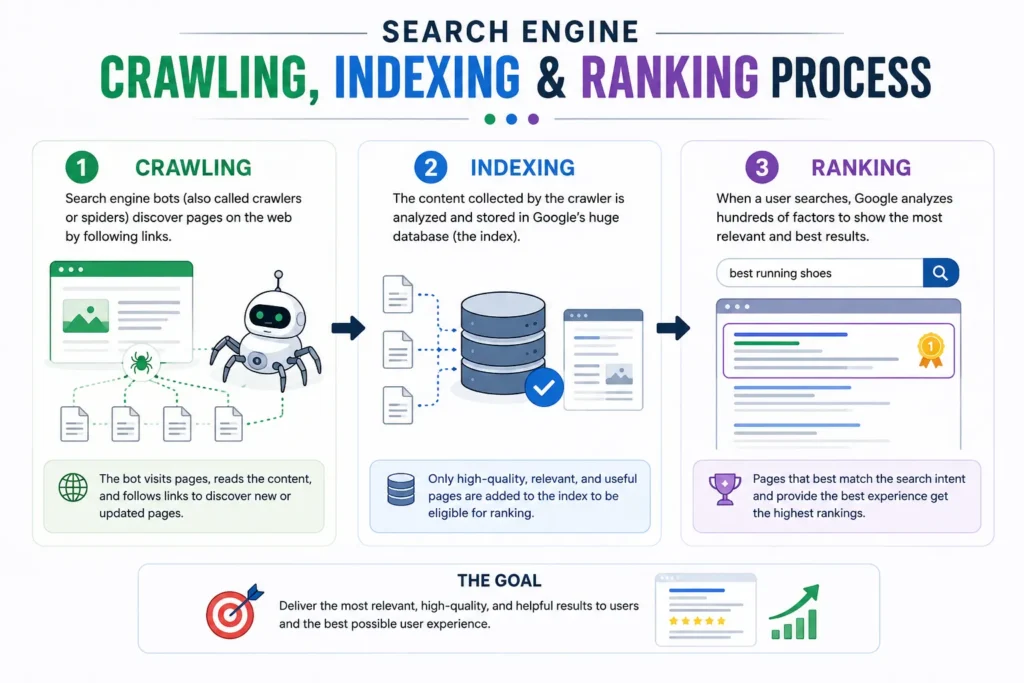
Search engines follow three primary steps:
1. Crawling
Search engine bots discover pages by following links across the web.
2. Indexing
After crawling, pages are analyzed and stored in the search engine’s index.
3. Ranking
When someone performs a search, the search engine evaluates hundreds of ranking signals to determine which pages best answer the user’s query.
The pages providing the highest quality, relevance, authority, and user experience typically rank at the top.
Types of SEO
1. On-Page SEO
On-page SEO focuses on optimizing the content and HTML elements of your website.
This includes:
- Title tags
- Meta descriptions
- Headings (H1-H6)
- Keyword optimization
- Internal linking
- Image optimization
- URL structure
- Content quality
- Readability
- User intent
2. Off-Page SEO
Off-page SEO improves your website’s authority through external signals.
Examples include:
- High-quality backlinks
- Brand mentions
- Digital PR
- Guest blogging
- Social sharing
- Local citations
3. Technical SEO
Technical SEO ensures search engines can efficiently crawl and understand your website.
It includes:
- Website speed
- Core Web Vitals
- Mobile friendliness
- XML sitemap
- Robots.txt
- HTTPS security
- Structured data
- Canonical tags
- Crawl error fixes
4. Local SEO
Local SEO helps businesses appear in location-based searches.
Examples:
- “SEO agency near me”
- “Best dentist in Delhi”
- “Digital marketing company in Noida”
Important local SEO elements include:
- Google Business Profile optimization
- Local citations
- Customer reviews
- Location pages
- Local keywords
5. E-commerce SEO
Online stores require specialized SEO strategies such as:
- Product page optimization
- Category pages
- Product schema
- Review schema
- Internal linking
- Faceted navigation optimization
How Search Engines Rank Websites
Search engines consider hundreds of factors, but the most important include:
Helpful Content
Content should answer users’ questions better than competing pages.
Search Intent
Your page should match what users are actually looking for.
Experience
Fast-loading, mobile-friendly websites perform better.
Authority
Trusted websites with quality backlinks tend to rank higher.
Freshness
Regularly updated content performs better for many topics.
User Experience
Easy navigation, readable formatting, and engaging content improve rankings.
Top SEO Ranking Factors in 2026
Some of the most important ranking factors include:
- Helpful, original content
- Strong E-E-A-T (Experience, Expertise, Authoritativeness, Trustworthiness)
- Mobile optimization
- Fast loading speed
- Core Web Vitals
- Secure HTTPS website
- Internal linking
- High-quality backlinks
- Image optimization
- Structured data
- Topical authority
- User engagement
- Clean site architecture
- Keyword relevance
- Accessibility
Keyword Research Explained
Keyword research helps identify what people are searching for online.
Instead of guessing topics, you create content based on actual search demand.
Example:
Broad keyword:
SEO
Better keyword:
What is SEO for beginners
Long-tail keyword:
How does SEO work for small businesses in 2026
Long-tail keywords often have lower competition and higher conversion rates.
How to Optimize a Page for SEO
Follow this simple checklist:
✓ Write a compelling title
✓ Create a persuasive meta description
✓ Use one H1 heading
✓ Include relevant H2 and H3 headings
✓ Naturally include your primary keyword
✓ Add related keywords
✓ Optimize images
✓ Write original content
✓ Add internal links
✓ Link to trusted external sources where appropriate
✓ Make content easy to scan
✓ Add FAQs
✓ Use schema markup
Common SEO Mistakes Beginners Make
Avoid these common errors:
- Keyword stuffing
- Publishing thin content
- Ignoring search intent
- Slow website speed
- Duplicate content
- Broken links
- Missing title tags
- Poor mobile experience
- Buying backlinks
- Ignoring technical SEO
- Forgetting internal linking
- Not updating old content
Best SEO Practices for 2026
To stay competitive:
- Focus on people-first content
- Demonstrate real expertise
- Cover topics comprehensively
- Improve page speed
- Optimize for mobile devices
- Use structured data
- Build topical authority
- Publish consistently
- Earn quality backlinks naturally
- Monitor SEO performance regularly
- Refresh outdated content
SEO vs Paid Ads
| SEO | Paid Ads |
|---|---|
| Organic traffic | Paid traffic |
| Long-term results | Immediate visibility |
| Builds trust | Stops when budget ends |
| Higher ROI over time | Ongoing ad spend |
| Sustainable growth | Short-term growth |
The most effective digital marketing strategies often combine both SEO and paid advertising.
Essential SEO Tools
Some useful tools include:
- Google Search Console
- Google Analytics 4
- Google Keyword Planner
- PageSpeed Insights
- Bing Webmaster Tools
- Ahrefs
- SEMrush
- Screaming Frog SEO Spider
- Yoast SEO
- Rank Math
Future of SEO
SEO continues to evolve with artificial intelligence, machine learning, and conversational search.
Success in 2026 depends on creating content that is:
- Helpful
- Accurate
- Original
- Trustworthy
- Well-structured
- User-focused
Businesses that prioritize quality over shortcuts are more likely to achieve sustainable rankings.
Final Thoughts
SEO is not about manipulating search engines—it’s about helping users find the most relevant, trustworthy, and valuable information.
By understanding how search works, creating genuinely helpful content, improving your website’s technical performance, and focusing on user experience, you can build long-term organic visibility and sustainable business growth.
Whether you’re launching your first blog or scaling an established website, investing in SEO today can continue delivering results for years to come.
Frequently Asked Questions (FAQs)
1. What is SEO in simple words?
SEO is the process of improving a website so it appears higher in search engine results and attracts more free organic visitors.
2. Is SEO free?
Yes. Organic SEO does not require paying for clicks, but it does require time, expertise, and consistent effort.
3. How long does SEO take to show results?
Most websites begin seeing noticeable improvements within 3 to 6 months, although competitive industries may take longer.
4. Is SEO better than Google Ads?
SEO provides long-term organic growth, while Google Ads deliver immediate traffic. Many businesses benefit from using both strategies together.
5. What is the difference between On-Page and Off-Page SEO?
On-Page SEO focuses on optimizing your website’s content and structure. Off-Page SEO focuses on building authority through backlinks, mentions, and other external signals.
6. Can I do SEO without coding?
Absolutely. Many SEO tasks—such as writing quality content, optimizing titles, improving internal links, and researching keywords—can be done without programming knowledge.
7. What is the most important SEO ranking factor?
There is no single ranking factor, but high-quality content that satisfies user intent remains one of the strongest signals for search visibility.
8. Does AI replace SEO?
No. AI can help create and improve content, but successful SEO still depends on expertise, originality, accuracy, technical optimization, and understanding user intent.
9. How often should I update my SEO content?
Review important pages every 6–12 months or sooner if industry information changes. Updating content can improve relevance and maintain rankings.
10. Why is user experience important for SEO?
A fast, mobile-friendly, easy-to-navigate website helps visitors find information quickly, which can improve engagement and support better search performance.